



Key takeaways
- Verified caller ID does not mean trustworthy caller. STIR/SHAKEN confirms a number wasn't tampered with but can't vouch for who's actually behind the call.
- Authentication weakens across network handoffs. As calls pass through IP and legacy networks, data can be stripped or inflated — up to 1 in 5 call segments receive inaccurate attestations.
- Fraudsters exploit routing, not just spoofing. Techniques like SIM boxing, grey routing, and telecom arbitrage disguise a call's true origin and mimic legitimate traffic patterns, with over 4 billion robocalls placed in April 2026 alone.
- Trust requires layered signals. Combining attestation, carrier reputation, ANI history, call velocity, and geographic consistency provide a fuller risk picture than authentication alone — the basis of solutions like FreeClimb's pre-answer risk scoring.
For years, voice security centered on a single question: “Is this caller ID authentic?” In many ways, STIR/SHAKEN answered it: If a call originates from a suspicious source or uses a spoofed number, the framework can help identify that risk before it reaches a recipient or drives up handle time.
But despite being a foundational tool for reducing unwanted calls, STIR/SHAKEN can’t prove that the person or organization behind the call is trustworthy. Fraud operators continue to exploit that visibility gap, with more than 4 billion robocalls placed in April 2026 alone.
Today’s challenge is no longer just verifying who a caller claims to be; it’s understanding how it reached you in the first place. And increasingly, that path runs through gaps in carrier networks, routing infrastructure, and attestation practices that can make illegitimate traffic appear trustworthy.
This blog explores where STIR/SHAKEN falls short, why understanding a call's origin matters, and what signals are critical for businesses to accurately identify and mitigate unwanted calls.
Why STIR/SHAKEN authentication is not enough to confirm call trust
STIR/SHAKEN introduced a crucial trust layer for domestic voice traffic, equipping carriers with a way to verify that caller ID information has not been tampered with in transit. However, it wasn’t designed to provide end-to-end visibility into a call’s journey across multiple networks.
Calls often traverse a patchwork of modern IP and legacy non-IP networks. At each handoff, authentication data can be stripped, degraded, or inconsistently preserved. As a result, calls may appear legitimate according to STIR/SHAKEN, but there may be authentication risks hidden beneath the surface.
In fact, up to 1 in 5 (20%) traffic segments receive inflated attestations from non-originating providers. In other cases, identity headers may be incomplete or missing altogether, limiting the ability for downstream providers to accurately assess trust.
How fraudsters are exploiting routing gaps to evade detection
Illegal robocall operations increasingly combine caller ID manipulation with routing-level techniques that obscure call origin across telecom infrastructure. For most authentication systems that verify calls at the network border or after they have already entered the environment, nuisance and nefarious calls can perfectly mirror legitimate ones.
Common nuisance call techniques include:
- SIM boxing: Bad actors use physical SIM cards to inject traffic into domestic mobile networks, allowing calls to appear locally originated and bypassing international termination controls.
- International grey routing or traffic pumping: A call is routed through low-governance jurisdictions with weak “Know Your Customer” practices to obscure its origin and blend into legitimate-looking local traffic.
- Telecom arbitrage and intermediary routing: Calls are passed through lower-cost carriers to reduce termination costs, sometimes degrading visibility into origin and influencing downstream trust signals.
Legitimate international callers, offshore employees, and roaming users may generate similar traffic patterns, making overly aggressive blocking risky. This creates a persistent balancing act between fraud prevention and false positives.
Regulatory efforts are underway to tighten the network through SIP origination requirements, stricter numbering policies, and improved transparency for international traffic, increasing urgency for organizations to evolve their risk detection frameworks.
Why businesses need a layered trust model
Because nuisance traffic increasingly mirrors legitimate behavior, organizations need to evaluate risk before a call reaches an IVR, virtual agent, or live representative. No single signal is sufficient; trust must be inferred from multiple data elements across the call path.
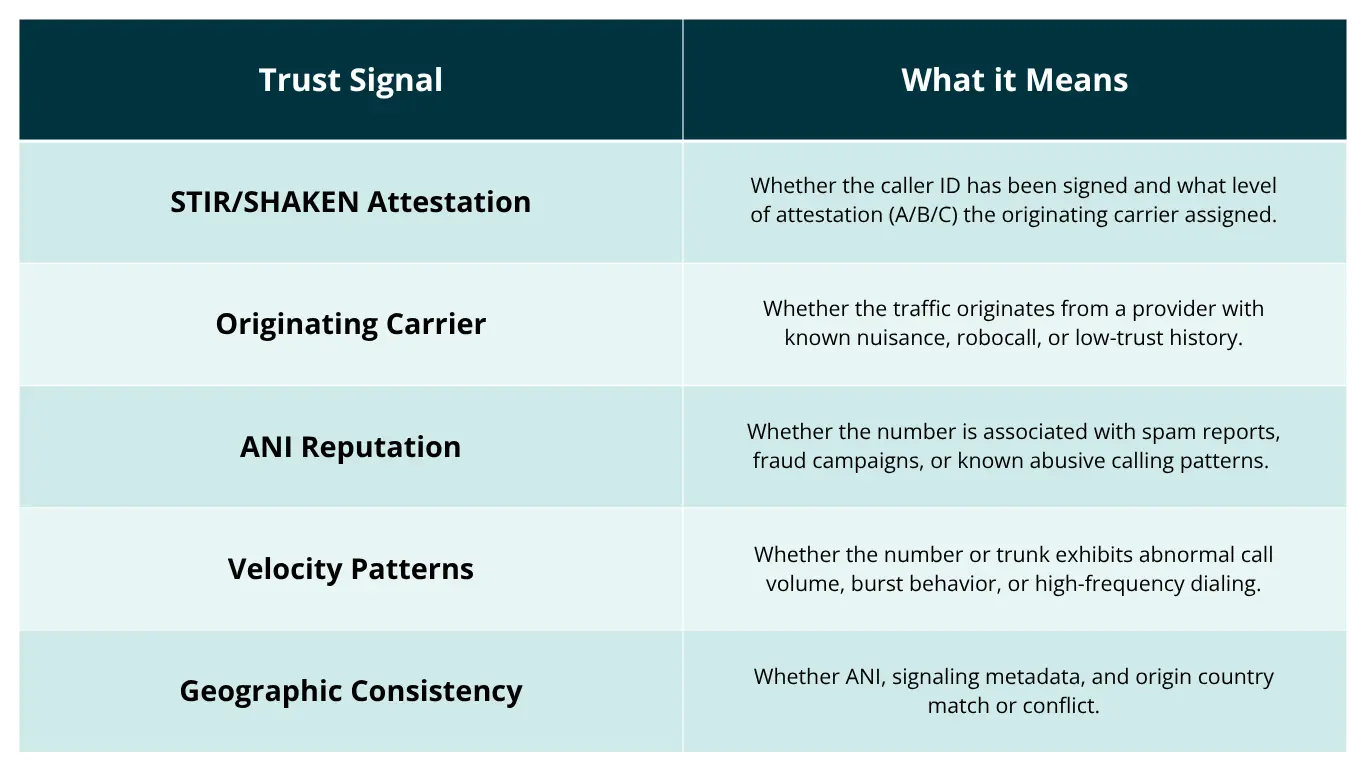
By combining attestation data with carrier reputation, historical caller behavior, and routing patterns, businesses can form a more complete view of risk than caller authentication alone.
Evolve beyond attestation to establish real trust
While STIR/SHAKEN remains a foundational advancement in telecom fraud prevention, limited call provenance visibility and uneven attestation practices have made it increasingly difficult to detect illegitimate calls from unwanted or fraudulent ones.
Effective risk mitigation depends on understanding not just who is calling, but how the call arrived. That requires pre-call signals that reveal call origin, routing behavior, carrier reputation, and traffic patterns — context that caller ID authentication alone cannot provide.
FreeClimb Risk Scoring Services classify risk at the earliest point — before a connection is established — by analyzing upstream carrier signaling, SIP-level metadata, and large-scale historical call patterns. Proven in the market for 7+ years, our pre-answer risk detection tools operate directly in the call path to surface fragments of truth about a caller that third-party overlays can’t. With a more comprehensive view of risk, businesses can precisely classify caller risk, reduce fraud exposure, and streamline the experience for legitimate callers.
FreeClimb Blog FAQs
Not necessarily. Caller ID verification (or STIR/SHAKEN) confirms that the number hasn't been altered or falsified, but it can't determine the intent or reputation of who is actually placing the call. Verified and trustworthy are separate questions; treating them as the same thing leaves a gap fraud operators can exploit.
A single call can pass through several different network types before it connects, and authentication details aren't always carried through cleanly at every step. Some segments end up with attestation levels that are higher than they should be, and others lose identifying information entirely, allowing unwanted traffic to look clean by the time it arrives.
A few tactics show up repeatedly:
- SIM boxing: Using banks of physical SIM cards so international traffic reads as local
- International grey routing/traffic pumping: Funneling calls through regions with minimal oversight to mask the true source
- Telecom arbitrage/intermediary routing: Bouncing traffic through cut-rate intermediary carriers, which can muddy origin data along the way
Not cleanly. Employees calling from abroad, remote staff, and people using roaming service can produce call patterns that look a lot like the ones fraud operators create. Blocking too aggressively risks cutting off real customers and partners along with the bad traffic.
A stronger approach pulls in several data points at once: the attestation level assigned to the call, whether the carrier handling it has a history of problematic traffic, whether the number itself is tied to past complaints or fraud activity, whether calling volume looks unusual for that number or line, and whether the number's origin actually matches its signaling and metadata.